

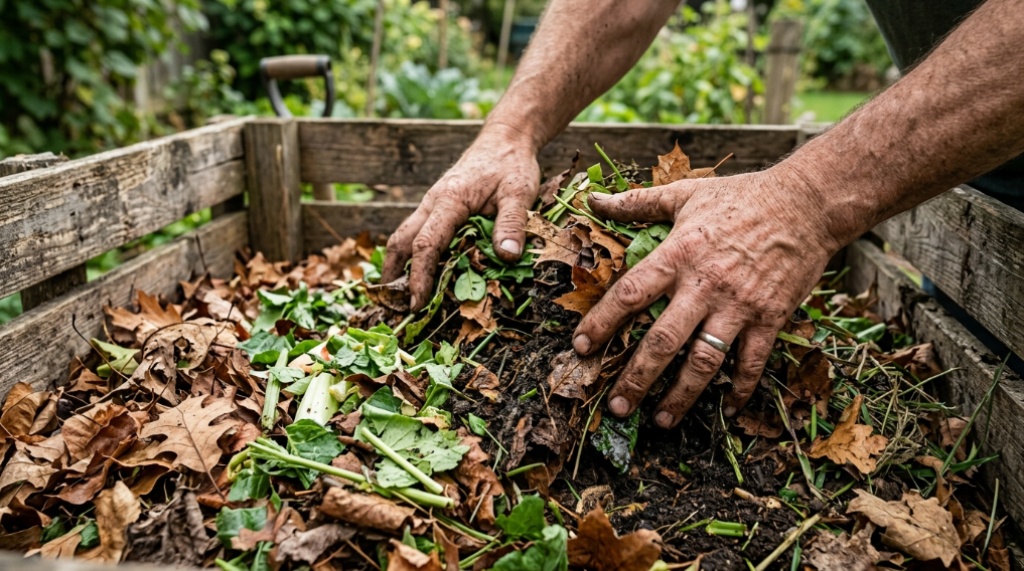
You add a bucket of kitchen scraps, a handful of dry leaves, and wait. Three weeks later the pile smells like a wet garbage can and nothing has broken down. That is almost never a problem with your bin, your climate, or your patience — it is a ratio problem. Carbon and nitrogen feed two different groups of organisms, and when the balance tips too far in either direction, decomposition stalls. The math is simpler than most guides suggest, and the practical rules stay the same whether you are turning a pile with a fork or using a tumbler, though a review that tested the Miracle-Gro dual-chamber tumbler shows how chamber size and airflow change the way you load browns and greens in practice. Below is what actually matters.
Quick Answer
Aim for roughly 25 to 30 parts carbon by weight for every 1 part nitrogen. In practice, that means about two to three volumes of dry, brown material (leaves, cardboard, straw, wood chips) for every one volume of wet, green material (grass clippings, food scraps, coffee grounds, manure). You do not need a scale or a calculator. You need to judge by feel: the finished mix should look like a wrung-out sponge and smell faintly earthy, not sour or ammonia-like.
Key Takeaways
- The 25–30:1 target is a weight ratio, but volume ratios of roughly 2–3 parts browns to 1 part greens get most backyard piles close enough.
- Browns are dry, tough, carbon-rich materials; greens are wet, soft, nitrogen-rich materials. Texture and moisture are better clues than color alone.
- Symptoms tell you which way to adjust: ammonia smell means too much nitrogen, and a dry, inert pile means too much carbon.
- Small batches in tumblers need more frequent ratio correction because there is less buffer volume to absorb mistakes.
- You can fix an imbalanced pile at any stage by adding the missing material and turning it — you rarely need to start over.
Why the Carbon-to-Nitrogen Ratio Matters
Composting microbes use carbon for energy and nitrogen to build proteins and reproduce. Carbon is the fuel; nitrogen is the building material. When the two are roughly matched to microbial demand — about 25 to 30 units of carbon per unit of nitrogen — the population grows fast and consumes the pile quickly.
Push the ratio too high and the microbes run out of nitrogen before they run out of fuel. They still work, but slowly, and the pile sits cool and dry for months. Push it too low and there is more nitrogen than the microbes can incorporate. The excess escapes as ammonia, which is the sharp smell that makes people think composting is unpleasant.
One important nuance: the 25–30:1 figure describes the starting material, not the finished compost. Finished compost has a much lower ratio, closer to 10–15:1, because microbes burn off carbon as carbon dioxide during decomposition. That is why a pile that starts correctly still shrinks dramatically.
Which Materials Count as Brown and Which Count as Green
The fastest way to classify a material is to ask two questions: is it dry and structurally tough, or is it wet and soft? Dry and tough almost always means carbon-dominant. Wet and soft almost always means nitrogen-dominant.
| Category | Typical materials | What it does in the pile |
|---|---|---|
| Browns (carbon) | Fallen leaves, shredded cardboard, newspaper, straw, sawdust, wood chips, corn stalks, dried plant stems | Adds structure and air pockets, absorbs excess moisture, slows nitrogen release |
| Greens (nitrogen) | Grass clippings, vegetable and fruit scraps, coffee grounds, tea leaves, fresh plant trimmings, manure from herbivores | Supplies the nitrogen microbes need, adds moisture, heats the pile |
| Ambiguous | Eggshells, citrus peels, onion skins, paper towels with food residue | Break down slowly or sit near the middle; treat as greens in small amounts |
Two materials trip people up constantly. Coffee grounds look brown but behave as a green — they are roughly 20:1 on their own. And shredded cardboard is not just filler; it is one of the most reliable carbon sources available to a backyard composter, and it breaks down far faster than whole sheets, Once your soil is nutrient-rich and your compost routine is running smoothly, you can start enhancing your landscape features by exploring inspiring wooden bridge ideas bringing charm to your backyard.
How to Hit the Ratio Without a Scale
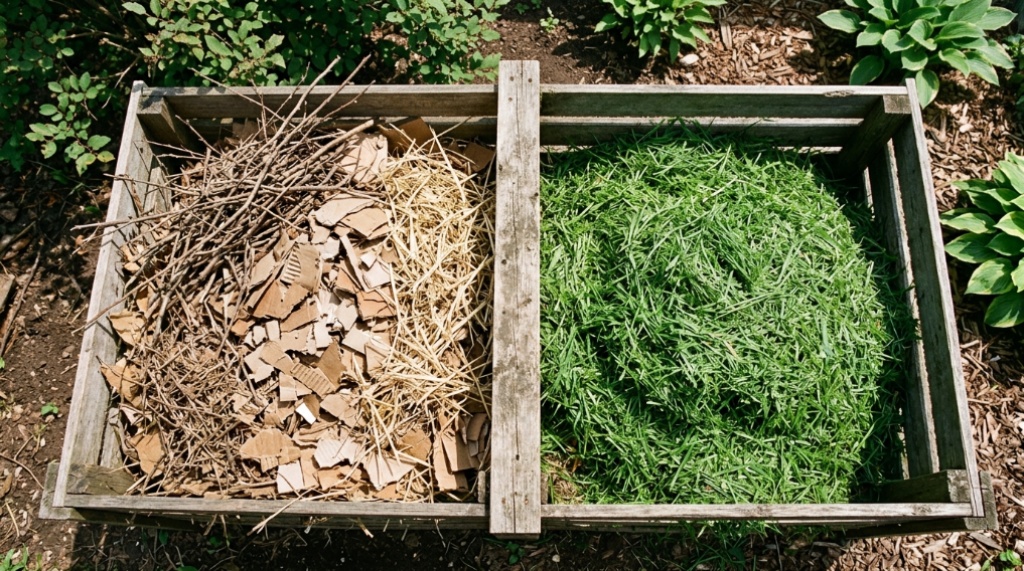
Weighing materials is impractical for most backyard composters, and it is unnecessary. Volume estimates get you close enough, and the pile itself will tell you if you are off.
- Start with a 2:1 or 3:1 volume ratio of browns to greens. Two packed buckets of shredded leaves to one bucket of kitchen scraps is a reasonable default for most household mixes.
- Chop or shred everything. Surface area matters more than exact ratio. A shredded leaf breaks down in weeks; an intact one can take a year.
- Mix rather than layer. Layering creates pockets of pure nitrogen that go anaerobic. Turn or stir so every scrap touches brown material.
- Squeeze test the moisture. Grab a handful and squeeze. It should feel like a damp sponge with no water dripping out. If it drips, add browns. If it crumbles, add water or fresh greens.
- Smell the pile after two or three days. Earthy and mild means you are close. Sharp, sour, or ammonia-like means add browns and turn.
- Adjust in small increments. Add one bucket of browns at a time and give it a few days before judging. Overshooting in either direction just creates a new problem.
What Goes Wrong When the Ratio Is Off
Most compost problems trace back to the ratio, and each symptom points to a specific correction.
| Symptom | Likely imbalance | Fix |
|---|---|---|
| Ammonia or rotten-egg smell | Too much nitrogen, often combined with too much moisture | Add shredded browns, turn thoroughly, leave the lid open briefly if rain is not forecast |
| Pile stays cool and dry, nothing breaks down | Too much carbon, not enough moisture or nitrogen | Add grass clippings or food scraps, water lightly, turn to mix |
| Fruit flies and gnats | Exposed food scraps, usually from burying greens too shallowly | Bury scraps in the center and cover with a full layer of browns |
| Large undecomposed chunks after months | Particle size, not ratio | Shred material finer and turn more often |
| Slimy, matted texture | Compaction and low oxygen | Add coarse browns like wood chips or straw, turn to reintroduce air |
Does Your Bin Change the Ratio?
The target ratio does not change, but the margin for error does. A large open pile of several cubic feet buffers mistakes — an extra bucket of grass clippings gets absorbed into the mass. A small enclosed tumbler holds far less material, so the same extra bucket can swing the whole batch.
That has practical consequences. In a tumbler, add greens in smaller, more frequent amounts rather than dumping a week of scraps in at once. Keep a supply of shredded cardboard or dry leaves next to the bin so you can add carbon immediately when you notice a smell. Turning frequency also matters more in a small batch, because oxygen depletes faster in a compact volume.
Dual-chamber designs add one more consideration: you are managing two batches at different stages. Load the active chamber with a correct ratio, then leave it alone while the finished side cures. Adding fresh greens to a nearly finished batch restarts the process and usually ruins the timing.
Common Mistakes That Throw Off the Balance
- Counting everything by eye instead of volume. A “handful” of leaves is not a meaningful measure. Use the same container for both browns and greens so the comparison is consistent.
- Treating grass clippings as harmless. Fresh clippings are nitrogen-heavy and mat into an oxygen-blocking layer. Spread them thin or dry them first.
- Adding browns without turning. Dumping leaves on top of a smelly pile does nothing. The materials have to be mixed.
- Ignoring moisture because the ratio looks right. Even a correct carbon-to-nitrogen ratio fails if the pile is bone dry or waterlogged. Moisture and ratio are separate variables.
- Assuming all leaves are equal. Fresh green leaves act more like a green; dry brown leaves are a strong carbon source. Timing of collection matters.
How to Rescue a Pile That Has Gone Wrong
You almost never need to discard a batch. Compost corrects itself once the limiting factor is removed.
For a smelly, wet pile: add a substantial volume of shredded cardboard or dry leaves — enough to visibly change the texture — then turn the entire pile so the new material is distributed. Expect the smell to fade within a few days. If it does not, add more browns.
For a dry, inactive pile: add fresh greens or a thin layer of grass clippings, water until the squeeze test passes, and turn. In cold weather, expect slower results regardless of ratio; microbial activity drops with temperature, and a pile under about a cubic yard loses heat quickly.
For a pile that has been sitting for months with no progress, check particle size first. Material that was never shredded can look unchanged even when the ratio is perfect.
Frequently Asked Questions
Can I compost without measuring at all?
Yes. Compost by feel: add roughly two to three times as much dry brown material as wet green material by volume, keep it as damp as a wrung-out sponge, and turn it when it smells off. The ratio is a guide for troubleshooting, not a rule you must calculate.
What if I only have kitchen scraps and no browns?
You can substitute shredded cardboard, paper towel rolls, newspaper, or junk mail without glossy coating. Cardboard is widely available and works well. Without any carbon source, food scraps alone tend to go anaerobic and smell strongly.
Does adding soil or finished compost help balance the ratio?
Not directly. Soil and finished compost introduce microorganisms, which speeds up the start of decomposition, but they do not supply meaningful carbon or nitrogen. Use them as an inoculant, not as a ratio fix.
How long should a properly balanced pile take?
A well-managed pile with the right ratio, moisture, and turning schedule can produce finished compost in roughly two to four months in warm weather. Cold temperatures slow the process significantly, and small batches take longer than large ones.
Is it possible to add too many browns?
Yes. Excess carbon stalls the pile by starving microbes of nitrogen, leaving a dry, cool mass that barely changes. The fix is straightforward — add greens, water, and turn — but it can take weeks to recover, so it is easier to avoid.
Do citrus peels and onions harm the compost?
In normal household quantities they are fine. They break down slowly and are mildly acidic, but a balanced pile neutralizes that quickly. Large volumes of citrus in a small tumbler can slow decomposition temporarily.
Conclusion
Balancing carbon and nitrogen comes down to one habit: add dry browns and wet greens in roughly a 2:1 or 3:1 volume ratio, mix them thoroughly, and keep the pile as damp as a wrung-out sponge. Then let the pile tell you what it needs. Ammonia smell means more browns; a dry, inert pile means more greens and water. Small tumblers demand more attention than large open piles because there is less room to absorb mistakes, but the correction is always the same. Start with a reasonable ratio, watch for the two main symptoms, and adjust in small steps.